Henry Villard (Henry Villard) — Northern Pacific Railway (Northern Pacific Railway)
Villard, a former journalist, used his famous "blind pool" in 1881 to raise the money to buy control of Northern Pacific, pushing out the incumbent president Billings, and completed the transcontinental line in September 1883. A few months after the line opened the money ran out; in December 1883 he was forced out by the terms set by his creditors, and in January 1884 he resigned as president. In 1887 he returned to the board on the strength of German capital, and in 1889 he became chairman; in his memoirs he said that this return was the greatest mistake of his life. Around the Panic of 1893 he resigned again, the company went bankrupt for the second time, and the Ives faction, newly in power, even took him to court. In this case it was not a "board" that originally forced him out but a syndicate of creditor banks; and after his return he purged no one, but was instead ousted a second time himself.
How they were ousted
After the railroad was completed, construction cost overruns and a collapse in the share price left him personally and his holding company on the brink of bankruptcy. Late on the night of 1883-12-16, the friends who were examining his books told him that the syndicate of creditor banks was willing to put up money to clean up the situation on condition that he resign as president of the holding company and its subsidiary; he agreed on the spot, and on 1884-01-04 he also resigned as president of Northern Pacific (forced to resign after a financial collapse, not dismissed by a board vote).
How they came back
He returned to the United States in 1886 as the New York representative of Deutsche Bank; in 1887-08 he brought in $5 million from Germany within 36 hours to rescue his old company, obtained proxies for nearly half of the shares, and rejoined the Northern Pacific board the same year. After the annual meeting in September 1889 he first served for a month as chairman of the finance committee and then took the newly created post of chairman of the board.
What happened to the board
When he returned to the board in 1887 he replaced no one; his memoirs even say that several directors who had previously been unfriendly to him took the initiative in inviting him back. Robert Harris, who had succeeded him as president, was replaced on 1888-09-20 by Villard's longtime subordinate Oakes, the only clear-cut personnel change; Billings, whom he had pushed out of the presidency in 1881, remained a director until his death in 1890. Conversely, after the company's bankruptcy in 1893 the board fell into the hands of the hostile Ives faction, Oakes was forced out as receiver, and Villard himself was sued (the memoirs say the suit was later dropped). Who the members of the bank syndicate that put up the rescue money in 1883 were, and what later became of them, the sources opened do not say.
Timeline
- Returns to the United States on behalf of German creditors In Germany Villard organized a committee for holders of defaulted American railroad bonds; in April 1874 he returned to the United States to deal with the arrangements for the Oregon and California Railroad, and in July he visited Portland for the first time. [Wikipedia: Henry Villard]
- Oregon Railway & Navigation created by merger He organized an American syndicate to buy the steamship company held by European investors, added the shipping and railroad operations on the Columbia River, and merged them into Oregon Railway & Navigation. [Wikipedia: Henry Villard]
- Billings becomes president of Northern Pacific Frederick Billings became the fifth president and, after a reorganization and bond sales, resumed laying track westward, posing a threat to Villard's business in the Northwest. [Wikipedia: Northern Pacific Railway]
- The "blind pool" buys control Villard raised money from friends without saying what it was for and used it to buy Northern Pacific stock. HistoryLink records that by the end of February his side already held 60%; accounts of the amount raised differ (Wikipedia's article on the railroad says $8 million, its article on the man $20 million). [HistoryLink.org Essay 2286(Greg Lange)] [Wikipedia: Northern Pacific Railway] [Wikipedia: Henry Villard]
- Billings resigns as president After a hard fight the Billings side conceded; he resigned as president but stayed on as a director. Ashbel Barney served briefly as acting president from June 19. [Wikipedia: Northern Pacific Railway] [Wikipedia: Frederick H. Billings]
- Villard elected president The shareholders' meeting elected a reconstituted board, and Villard became the sixth president. [Wikipedia: Henry Villard] [Wikipedia: Northern Pacific Railway]
- Second-mortgage bonds issued; Deutsche Bank comes in As the construction overruns snowballed, the company issued $20 million of second-mortgage bonds, most of them underwritten by German banking houses; this was the start of Deutsche Bank's relationship with the company. But the debt ranked ahead of the stock, and the share price fell even harder. [Wikisource:Memoirs of Henry Villard 第二卷第 42 章(1883~1890)]
- Insiders sell short According to Villard's memoirs, in the fall of 1883 two directors of Oregon & Transcontinental used inside information to short the company's stock heavily; the newspapers that had once lauded him also turned to attacking him. He did not say who the two directors were. [Wikisource:Memoirs of Henry Villard 第二卷第 42 章(1883~1890)]
- The rails are actually joined His crews laid an average of a mile and a half of track a day, and the transcontinental line was technically completed on this day. [Wikipedia: Northern Pacific Railway]
- The last-spike ceremony Villard chartered five special trains to carry about 300 distinguished guests to Montana, including former President Grant and his in-laws, the Garrison family; a short stretch of track was first taken up and then relaid on the spot, and the last spike was driven. [Wikipedia: Northern Pacific Railway] [HistoryLink.org Essay 2286(Greg Lange)]
- Bad news received in Seattle A week after the ceremony he arrived in Seattle, greeted by a band; telegrams received there showed that his companies were in financial trouble. [HistoryLink.org Essay 2286(Greg Lange)]
- Asks friends to examine the books In late November, concluding that he could save neither himself nor the holding company, he called together his most trusted friends, Fabbri, Endicott and Rolston, handed over his books and promised in advance to accept whatever they decided. [Wikisource:Memoirs of Henry Villard 第二卷第 42 章(1883~1890)]
- Told late at night: money only if he resigns Having finished examining the books, the three went to his hotel late on the night of the 16th and woke him: he was in substance insolvent and the holding company was on the brink of bankruptcy; the bank syndicate was willing to advance funds on condition that he resign as president of Oregon & Transcontinental and Oregon Railway & Navigation. He accepted on the spot. [Wikisource:Memoirs of Henry Villard 第二卷第 42 章(1883~1890)]
- Afternoon papers report his resignation New York's evening papers reported that he had resigned as president of the two companies he had founded. [Wikisource:Memoirs of Henry Villard 第二卷第 42 章(1883~1890)]
- Attacked for moving into the mansion; an inquiry clears him After resigning he moved, to save money, into the already completed mansion on Madison Avenue, and some newspapers attacked him for having kept his own fortune. An investigating committee then announced that he had turned over all his property to his creditors and that no dishonesty had been found, and only then did public opinion shift. [Wikisource:Memoirs of Henry Villard 第二卷第 42 章(1883~1890)]
- Resigns as president of Northern Pacific Villard resigned as president; his memoirs say that after prolonged insomnia he was mentally exhausted and unable to work. He was succeeded by Robert Harris, a career railroad man. [Wikipedia: Henry Villard] [Wikipedia: Northern Pacific Railway] [Wikisource:Memoirs of Henry Villard 第二卷第 42 章(1883~1890)]
- New management shuts down the Seattle line The Seattle branch he had promoted opened only on June 17 and was shut down on August 22, lying idle for about 14 months; HistoryLink says the managers who took over had no stake in his Oregon companies and regarded Seattle as a competitor of Tacoma. [HistoryLink.org Essay 2286(Greg Lange)]
- Returns to the United States as Deutsche Bank's representative In Berlin he became Deutsche Bank's adviser on American matters, and the two sides agreed that he would represent the bank in New York. The family set out at the end of September; on the way he sold the Madison Avenue house to Whitelaw Reid and paid off the last debts left over from 1883. [Wikisource:Memoirs of Henry Villard 第二卷第 42 章(1883~1890)]
- Rejoins the Northern Pacific board He had intended to act only as a financier and take no position, but after several days of urging from all sides he agreed to return to the board. At the annual meeting he voted 365,799 of the 754,193 shares on behalf of others, with not a single share in his own name. [Wikisource:Memoirs of Henry Villard 第二卷第 42 章(1883~1890)] [Wikipedia: Northern Pacific Railway]
- $5 million brought in within 36 hours Elijah Smith, president of Oregon & Transcontinental, came to him for help. Villard cabled his German clients, and $5 million was remitted to New York within 36 hours; the other side handed over management control and proxies sufficient to decide the election of Northern Pacific's directors. The newspapers called him the railroad king restored to his throne. [Wikisource:Memoirs of Henry Villard 第二卷第 42 章(1883~1890)]
- Returns as president of Oregon & Transcontinental His memoirs record that he was elected on June 28 (Wikipedia says June 21), while he was still in Germany. [Wikisource:Memoirs of Henry Villard 第二卷第 42 章(1883~1890)] [Wikipedia: Henry Villard]
- Oakes becomes president of Northern Pacific Villard was asked to return as president but declined; his longtime subordinate Oakes took the post, and Harris left. [Wikipedia: Northern Pacific Railway] [Wikipedia: Thomas Fletcher Oakes]
- Edison General Electric formed He merged Edison's several electric light and manufacturing companies into Edison General Electric, with capital of $12 million; he and his German partners held a majority, and he served as president. [Wikisource:Memoirs of Henry Villard 第二卷第 42 章(1883~1890)] [Wikipedia: Henry Villard]
- Board approves $160 million consolidated mortgage The consolidated mortgage plan he had led in designing was finalized on this day, with a ceiling of $160 million, to replace old debt and pay for branch lines, terminals and the like. [Wikisource:Memoirs of Henry Villard 第二卷第 42 章(1883~1890)]
- Takes the newly created post of chairman of the board After the September annual meeting he first served for a month as chairman of the finance committee, then took the post of chairman of the board, newly created for him, with responsibility for all matters other than operations. [Wikisource:Memoirs of Henry Villard 第二卷第 42 章(1883~1890)]
- Billings dies Billings, whom he had pushed out in 1881 and who had remained a director ever since, died in Vermont. [Wikipedia: Frederick H. Billings]
- His principal brokerage firm fails Decker, Howell & Co., the brokerage that had handled his operations for years, failed on this day with liabilities of $12 million; in his memoirs he called it an almost fatal blow. [Wikisource:Memoirs of Henry Villard 第二卷第 43 章]
- Squeezed out of Edison General Electric J. P. Morgan led the merger of Edison General Electric and Thomson-Houston into General Electric; the other side's board took charge, and Villard left the presidency. [Wikipedia: Henry Villard] [Wikisource:Memoirs of Henry Villard 第二卷第 42 章(1883~1890)]
- Board accepts his resignation as chairman He had announced at the start of the year that he would resign all his posts; the board accepted at its meeting of June 21, effective July 19, and passed a series of resolutions thanking him. [Wikisource:Memoirs of Henry Villard 第二卷第 44 章(1890~1900)]
- Ives writes a letter denouncing the board Brayton Ives wrote to the board criticizing it for praising Villard while accepting his resignation, and set out item by item the deterioration of the company's finances during Villard's control. [Theodore Roosevelt Center:Brayton Ives 致 Northern Pacific 董事會函(1893-08-03,國會圖書館藏)]
- Second bankruptcy; Ives becomes president The company went into receivership, with Oakes as one of the receivers, and Ives was elected president the same day. (The memoirs say receivers had already been appointed in mid-August.) [Wikipedia: Northern Pacific Railway] [Wikipedia: Brayton Ives] [Wikisource:Memoirs of Henry Villard 第二卷第 44 章(1890~1900)]
- Takes his family to Europe Villard sailed with his family directly to Gibraltar, announcing before he left that he was withdrawing from all business activity. [Wikisource:Memoirs of Henry Villard 第二卷第 44 章(1890~1900)]
- The new ruling faction files charges in court The faction that won the company in the annual election after the receivership filed charges against Oakes and Villard in early 1894 in the federal circuit court that had appointed the receivers; according to the memoirs, the resulting inquiry recommended that the court order suit to be brought against Villard. [Wikisource:Memoirs of Henry Villard 第二卷第 44 章(1890~1900)]
- Returns to the United States to answer the charges He notified the receivers that he was back in the United States and available to be summoned at any time. The following winter the court issued a further order, and only then was the suit formally brought, but it went no further than complaint and answer. [Wikisource:Memoirs of Henry Villard 第二卷第 44 章(1890~1900)]
- The presidency changes hands twice After three years of struggle between the Ives and Villard–Oakes factions, with three courts contesting jurisdiction, Edward Dean Adams first became president in 1896 and was replaced by Edwin Winter in less than two months. [Wikipedia: Northern Pacific Railway]
- Morgan takes over the reorganization The company was handed to J. P. Morgan for reorganization, carried out by his lieutenant Charles Henry Coster, with Charles S. Mellen as president from this day. According to Villard's memoirs, the suit against him was dropped after the reorganization was completed. [Wikipedia: Northern Pacific Railway] [Wikisource:Memoirs of Henry Villard 第二卷第 44 章(1890~1900)]
- Villard dies He died of a stroke at Thorwood Park, his country home in Dobbs Ferry, New York, and was buried in Sleepy Hollow Cemetery. [Wikipedia: Henry Villard]
People
- Henry Villard (Henry Villard), 1835-04-10 — Sixth president of Northern Pacific (1881-09-15 to 1884-01-04); chairman of the board 1889–1893. Born in Speyer, Bavaria, as Heinrich Hilgard; emigrated to the United States in his teens without his parents' knowledge and changed his name. As a journalist he covered Lincoln and the Civil War, and in 1866 he married Fanny, daughter of the abolitionist William Lloyd Garrison. In the 1870s he handled American railroad defaults on behalf of bondholders in Germany, and from there moved into railroad finance. In 1874 he went to Oregon on behalf of German creditors, and in 1879 he created Oregon Railway & Navigation through a merger. Unable to reach a long-term agreement with Northern Pacific, in 1881 he bought control of Northern Pacific with the "blind pool" money that friends lent him without asking what it was for, and formed a separate holding company, Oregon & Transcontinental. Oakes was a longtime subordinate he had known since his Kansas Pacific days; Billings was the previous president whom he had pushed out; Deutsche Bank became his backer from the sale of the second-mortgage bonds in 1883. On 1893-06-21 the board accepted his resignation as chairman, effective July 19; in November he took his family to Europe. He died of a stroke on 1900-11-12 at his country home in Dobbs Ferry, New York; his memoirs were published in 1904. [Wikipedia: Henry Villard] [Wikipedia: Northern Pacific Railway] [Wikisource:Memoirs of Henry Villard 第二卷第 42 章(1883~1890)] [Wikisource:Memoirs of Henry Villard 第二卷第 44 章(1890~1900)]
- Frederick Billings (Frederick H. Billings), 1823-09-27 — Fifth president of Northern Pacific (1879-05-24 to 1881-06-09); afterwards remained a director. Born in Vermont and a graduate of the University of Vermont; went to California during the Gold Rush as a lawyer handling land cases. In 1869 he bought a one-twelfth interest in Northern Pacific, became a director in 1870, and after the Panic of 1873 drew up the reorganization plan that saved the company. Director and chairman of the land committee from 1870; promoted to president in 1879. In 1881 Villard bought control; after resisting unsuccessfully he resigned as president but stayed on the board, and in 1883 he attended the last-spike ceremony. His role in Villard's fall in 1883–1884 is not recorded in the sources opened. Remained a director throughout. A stroke in December 1889 left him partly paralyzed, and he died in Woodstock, Vermont, in September 1890 (the same Wikipedia article gives both September 23 and September 30). The city of Billings, Montana, is named after him. [Wikipedia: Frederick H. Billings] [Wikipedia: Northern Pacific Railway]
- Robert Harris (Robert Harris), 1830 — President of Northern Pacific (1884–1888). A career railroad man who had headed the Chicago, Burlington and Quincy Railroad. The dates 1830–1894 are taken from the Theodore Roosevelt Center's name heading. Became president after Villard resigned in January 1884. Not one of Villard's men. During his tenure he improved the condition of the line and sought to end the entanglement with Oregon Railway & Navigation; he kept Oakes on as executive vice president. After the Villard faction returned, the presidency passed to Oakes on 1888-09-20. Whether he resigned of his own accord or was replaced, the sources do not make clear. He died in 1894. [Wikipedia: Northern Pacific Railway] [Wikipedia: Thomas Fletcher Oakes] [Theodore Roosevelt Center:Brayton Ives 致 Northern Pacific 董事會函(1893-08-03,國會圖書館藏)]
- Thomas Oakes (Thomas Fletcher Oakes), 1843-07-15 — Vice president and general manager of Northern Pacific; president from 1888-09-20. Born in Boston; entered the railroad business in 1863 and rose to general superintendent at Kansas Pacific. In 1880 he became vice president and general manager of Oregon Railway & Navigation, and in May 1881 he moved to Northern Pacific as vice president. Followed Villard from the Oregon companies into Northern Pacific. An old acquaintance of Villard from his Kansas Pacific days; Villard declined to return as president, and Oakes took the post. Greatly expanded the branch lines during his tenure. When the company went bankrupt in 1893 he was appointed one of the receivers, and he was later forced out as receiver amid the melee in which the Ives faction and three courts fought over jurisdiction. He died in Seattle on 1919-03-14. [Wikipedia: Thomas Fletcher Oakes] [Wikipedia: Northern Pacific Railway] [Wikisource:Memoirs of Henry Villard 第二卷第 44 章(1890~1900)]
- Brayton Ives (Brayton Ives), 1840-08-23 — New York financier; president of Northern Pacific from 1893-10-20. Born in Connecticut and graduated from Yale in 1861; in the Civil War he rose to colonel of a cavalry regiment and brevet brigadier general. He then became a New York financier, serving two terms as president of the New York Stock Exchange and as president of the Western National Bank. Leader of the opposition after Villard's departure; elected president on the day the company went bankrupt (1893-10-20). On 1893-08-03 he wrote to the board criticizing it for lavishly praising Villard while accepting his resignation, and listing the deterioration of the company's finances under Villard's control. For the next three years he fought the Villard–Oakes faction for control. Served as president until 1896 and left after the company's reorganization passed into the hands of J. P. Morgan. He died on 1914-10-22. [Wikipedia: Brayton Ives] [Wikipedia: Northern Pacific Railway] [Theodore Roosevelt Center:Brayton Ives 致 Northern Pacific 董事會函(1893-08-03,國會圖書館藏)]
- Charles Wright (Charles Barstow Wright), 1822-01-08 — Fourth president of Northern Pacific (1875–1879); Philadelphia financier. Born in Pennsylvania; was in Chicago real estate and Pennsylvania oil. From 1870 he promoted Northern Pacific as a director and later as president, and led the choice of Tacoma as the western terminus. Became a director in 1870 and took over as president in 1875 after the company's first bankruptcy. Represented Tacoma's interests, at odds with Villard's plans, which favored Portland and Seattle; what he actually did in the events of 1883–1884 is not recorded in the sources opened. Died at his home in Philadelphia on 1898-03-24. [Wikipedia: Charles Barstow Wright] [HistoryLink.org Essay 2286(Greg Lange)]
- Fabbri, Endicott and Rolston (three friends) (Fabbri, Endicott, Rolston) — The group of friends who examined Villard's books in December 1883. Villard's memoirs give only the three men's surnames and call them his most faithful and most influential friends; their full names and backgrounds could not be confirmed from the sources opened. In late November 1883 Villard, knowing he could not hold out, asked them to meet and handed over his books, promising in advance to accept whatever they concluded. The three examined his personal accounts and those of Oregon & Transcontinental day and night, and late on the night of December 16 went to his hotel, woke him and conveyed the bank syndicate's terms. The investigating committee later stated publicly that he had turned over all his property to his creditors and that nothing had been found to cast doubt on his integrity. The three men's later careers were not researched. [Wikisource:Memoirs of Henry Villard 第二卷第 42 章(1883~1890)]
- Elijah Smith (Elijah Smith) — President of Oregon & Transcontinental and of Oregon Railway & Navigation in 1887. His background is not recorded in the sources consulted. Took charge of the two companies after Villard stepped down. On 1887-08-27 he came to Villard for help, bringing a representative of a brokerage firm in crisis; he asked for $5 million and said he was willing to hand over the management of both companies and proxies sufficient to sway the election of Northern Pacific's directors. On 1888-06-28 Villard was elected president of Oregon & Transcontinental, replacing him; his later fate was not researched. [Wikisource:Memoirs of Henry Villard 第二卷第 42 章(1883~1890)]
- Edward Adams (Edward Dean Adams), 1846-04-09 — Banker; U.S. representative of Deutsche Bank from 1893, and briefly president of Northern Pacific in 1896. Born in Boston; a banker and coin collector known for corporate reorganizations, who later headed the hydroelectric power company at Niagara Falls. In 1893 he took over as Deutsche Bank's U.S. representative and took part in the reorganization of Northern Pacific. In effect he took over the role Villard had played for Deutsche Bank. Appointed president in 1896 and replaced by Edwin Winter in less than two months; the company was ultimately reorganized by J. P. Morgan's people, with Charles S. Mellen as president from 1897-09-01. He died on 1931-05-20. [Wikipedia: Edward Dean Adams] [Wikipedia: Northern Pacific Railway]
- Helen Frances Garrison Villard (Fanny) (Helen Frances Garrison Villard), 1844 — Villard's wife; women's suffrage campaigner. The only daughter of the abolitionist William Lloyd Garrison; she married Villard in January 1866 and they had four children. Held no position in the company. The Garrison family was invited along to the last-spike ceremony in 1883; after the collapse the whole family moved into the not-yet-occupied mansion on Madison Avenue, which became material for attacks in the newspapers. Died in 1928. Three years after Villard's death, their daughter Helen sued the executors of the will, claiming that her father had been unduly influenced by his wife and two sons when he made it; she lost the case in 1905. [Wikipedia: Henry Villard] [Wikipedia: Northern Pacific Railway] [Wikisource:Memoirs of Henry Villard 第二卷第 42 章(1883~1890)]
Moves to block a return
- The syndicate of creditor banks set its terms: it was willing to advance funds to deal with his personal debts and those of Oregon & Transcontinental, but he had to resign as president of that company and of Oregon Railway & Navigation. He himself understood that losing the holding company meant losing Northern Pacific. [Wikisource:Memoirs of Henry Villard 第二卷第 42 章(1883~1890)]
- The management that took over had no stake in his Oregon companies: President Harris spent four years working to cut Northern Pacific's entanglement with Oregon Railway & Navigation, and the Seattle branch that Villard had pushed for was shut down on 1884-08-22 and lay idle for about 14 months. This did not prevent his return, but it dismantled the arrangements he had built. [Wikipedia: Northern Pacific Railway] [HistoryLink.org Essay 2286(Greg Lange)]
- The Union Pacific faction sought to gain control of Northern Pacific through Oregon & Transcontinental, and before the shareholders' meeting of June 1889 it fought the Villard faction for shares and proxies. According to his memoirs, after this battle he never again had any say over Oregon Railway & Navigation, the company he had founded himself. [Wikisource:Memoirs of Henry Villard 第二卷第 42 章(1883~1890)]
- After the company went into receivership, a faction hostile to the old management won Northern Pacific in the annual election, and in early 1894 it filed a series of charges against Oakes and Villard in the federal circuit court; the court later ordered suit to be brought against Villard. According to his memoirs, the litigation stopped at the stage of complaint and answer and was dropped once the reorganization was completed. [Wikisource:Memoirs of Henry Villard 第二卷第 44 章(1890~1900)]
Rumors
- Villard sacrificed the investors who had followed him but kept his own fortune, which is how he could afford to live in the Madison Avenue mansion. [Proven false] Some New York newspapers (as recounted in Villard's memoirs) The investigating committee that examined his accounts stated publicly that he had surrendered all the property in his name to pay his debts and that no dishonesty had been found. Note that this finding comes from his own memoirs; no independent source was found. [Wikisource:Memoirs of Henry Villard 第二卷第 42 章(1883~1890)]
- As soon as the $5 million arrived, Villard would immediately take charge of the three companies again. [Still unclear] New York newspapers in late August 1887 Partly came true: he at first refused all positions and a few days later agreed only to return to the Northern Pacific board; he became president of Oregon & Transcontinental only in 1888 and chairman only in 1889, and he never returned as president of Northern Pacific. [Wikisource:Memoirs of Henry Villard 第二卷第 42 章(1883~1890)] [Wikipedia: Northern Pacific Railway]
- Villard and his associates made millions of dollars for themselves through the Chicago & Northern Pacific terminal company. [Still unclear] Newspapers in 1893; a minority shareholder also sued on this basis In his memoirs he denied it entirely, saying that the suit was dropped after the reorganization was completed and that those in charge of the reorganization issued a statement that no evidence had been found; but this is only one party's account, and the sources opened contain no court documents against which to check it. [Wikisource:Memoirs of Henry Villard 第二卷第 44 章(1890~1900)]
Views
- Wikipedia's article on Northern Pacific: It attributes the company's second bankruptcy to mismanagement, sparse traffic and the Panic of 1893, and calls the lease of the Wisconsin Central and the heavy building of terminals in Chicago a costly blunder. [Wikipedia: Northern Pacific Railway]
- Family: The sources opened record no comment from his wife or children on his two departures; all that was found is that after his death his daughter Helen sued her mother's and brothers' side over the will and lost in 1905. [Wikipedia: Henry Villard]
- The New York press: Newspapers that had once lauded Villard turned to criticizing his companies, and later attacked his management and his character as well. [Wikisource:Memoirs of Henry Villard 第二卷第 42 章(1883~1890)]
- Wall Street bears (as summarized by Wikipedia): They shorted the stock soon after the last spike was driven, on the grounds that the road was very long and had very little business. [Wikipedia: Northern Pacific Railway]
- Villard himself (memoirs): He said his own judgment had never favored the step, regarded taking on responsibility for the company again as the greatest mistake of his life, and later regretted it deeply. [Wikisource:Memoirs of Henry Villard 第二卷第 42 章(1883~1890)]
- The Northern Pacific board: Passed a series of resolutions thanking him for his services to the company. [Wikisource:Memoirs of Henry Villard 第二卷第 44 章(1890~1900)]
- Brayton Ives (New York financier, later president): He held that the board should not be singing Villard's praises at such a time, and listed how the company's finances had steadily deteriorated under Villard's control. [Theodore Roosevelt Center:Brayton Ives 致 Northern Pacific 董事會函(1893-08-03,國會圖書館藏)]
Photos & videos
 Villard in 1866, when he was still a newspaper reporter; he married Fanny Garrison that year. — 作者不詳 / Public domain
 Northern Pacific preferred stock certificate, issued 1881-11-28, a little over two months after Villard was elected president. — 作者不詳(掃描:EDHAC e.V.) / Public domain
 The last-spike ceremony at Gold Creek, Montana, on 1883-09-08 (a photographic copy of an illustration); former President Grant was also present. — 作者不詳 / Public domain
 The Fifth Infantry band at the last-spike ceremony, photographed by F. Jay Haynes, 1883-09-08. The photograph is actually titled "Villard Gold Spike Excursion". — F. Jay Haynes (Little Bighorn Battlefield National Monument) / Public domain
 Seattle celebrating the opening of the Northern Pacific on 1883-09-16, with the steamer Queen of the Pacific entering the harbor. Villard arrived in Seattle that very day and received the telegrams about his companies' financial trouble. — 作者不詳 / Public domain
 Villard in 1887 (photographed by Wilhelm Höffert), the year he returned to the Northern Pacific board on the strength of German capital. — Wilhelm Höffert / Public domain
 Profile photograph of Villard at 53 (by George C. Cox), from about the time he returned as president of Oregon & Transcontinental and was about to become chairman; included in his memoirs, published in 1904. — G. C. (George Collins) Cox, New York, 1851-1902 / Public domain
 Full-length photograph of Villard at 54, Sarony studio, New York; included in his memoirs, published in 1904. — Sarony, New York / Public domain
 Northern Pacific stock certificate, issued 1894-03-21, when the company had gone bankrupt a second time and was in the hands of receivers, and Villard was facing charges from the new ruling faction. — 作者不詳(掃描:Auktionshaus Vladimir Gutowski) / Public domain
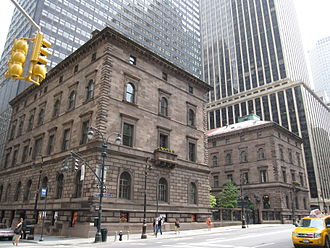 The Villard Houses on Madison Avenue, New York (photographed 2010). He moved in here after his collapse at the end of 1883 and was attacked in the newspapers as "living in a mansion and mocking the shareholders who lost money". — Gryffindor / CC BY-SA 3.0
 Villard Hall at the University of Oregon (photographed 2014). In 1883 he paid off the university's debts and donated $50,000, and the building was named after him. — Another Believer / CC BY-SA 3.0
 The Northern Pacific completion site in Powell County, Montana (where the last spike was driven in 1883), photographed 2020; listed on the U.S. National Register of Historic Places. — Jon Roanhaus / CC BY-SA 4.0
 Villard's signature, from his memoirs, published in 1904. — Henry Villard / Public domain
- Lakeland PBS public television documentary "Main Street of the Northwest": the story of the Northern Pacific Railway. (Lakeland PBS)
- KPTV FOX 12 Oregon, "This Day in Oregon History": transcontinental railroad pioneer Henry Villard dies on 1900-11-12. (KPTV FOX 12 Oregon)