Napoleon I (Napoleon I) — First French Empire (First French Empire)
In the spring of 1814 the armies of the anti-French coalition fought their way into Paris. The former foreign minister Talleyrand formed a provisional government and had the Senate depose the emperor; the marshals at Fontainebleau refused to fight on, Marmont's troops went over to the Allies, and Napoleon was forced to abdicate in exchange for sovereignty over tiny Elba. In less than a year he was back, and, unexpectedly, he settled scores with almost no one: Ney, who had led the pressure on him to abdicate, instead became commander of his left wing, and the police chief Fouché returned as a minister. After Waterloo he abdicated again and was exiled to St Helena. This case is a counter-example: most of those who abandoned him in 1814 came through unscathed or even rose steadily higher; Ney, the only one to be shot, was executed by the restored Bourbon monarchy because he had gone back over to Napoleon in 1815.
How they were ousted
Paris fell at the end of March 1814, and under Talleyrand's direction the Senate declared him deposed on 2 April; on 4 April Ney and other marshals told him to his face at Fontainebleau that he must abdicate, that night Marmont's VI Corps marched into the Allied lines, and on 6 April he abdicated unconditionally and was sent to the island of Elba.
How they came back
On 1815-02-26 he left Elba with about a thousand men and on 1 March landed at Golfe-Juan; the forces sent to stop him along the way (including Ney) went over to him one after another, and on the evening of 20 March he entered Paris without a shot being fired — the period known as the “Hundred Days”.
What happened to the board
In the hundred-odd days after his return, Napoleon took almost no action against those who had forced his abdication or defected in 1814: Marmont was excluded from the amnesty and struck from the list of marshals, but he had already fled to Ghent with Louis XVIII and was entirely unharmed; Augereau tried to come back over to him, was refused and was denounced as a traitor; Talleyrand was in Vienna and went on conducting diplomacy for the Bourbons. Ney and Lefebvre served him again; Macdonald, Oudinot and Moncey declined to follow him again and also came to no harm; Berthier fell to his death from a window at Bamberg on 1815-06-01, the cause of death unclear. After Waterloo it was the Bourbon monarchy that settled the accounts: Talleyrand became prime minister, Marmont and Macdonald continued in high position, and Fouché first served as a minister and was only exiled as a regicide in 1816; Ney, who had gone back over to Napoleon, was shot on 1815-12-07, and among the members of the Chamber of Peers who voted for his execution was Marmont.
Timeline
- Defence of Paris: Marmont seeks a ceasefire The Allies broke through the Clichy barrier and poured onto the plain of Saint-Denis. At about four in the afternoon Marmont, defending the city, tried to negotiate a twenty-four-hour ceasefire to give the emperor time to get back. Moncey held out at Clichy with the National Guard. [Fondation Napoléon:Mars-avril-mai 1814(年表)] [Wikipedia: Bon-Adrien Jeannot de Moncey] [Wikipédia(法文):Auguste Frédéric Viesse de Marmont]
- Paris capitulates The capitulation was signed at two in the morning and the French army left the capital. After entering the city the Allies announced that they would no longer negotiate with Napoleon or his family. Talleyrand stayed in Paris and lodged Tsar Alexander in his own house. [Fondation Napoléon:Mars-avril-mai 1814(年表)] [Wikipédia(法文):Auguste Frédéric Viesse de Marmont] [Wikipedia: Treaty of Fontainebleau (1814)] [Wikipedia: Charles Maurice de Talleyrand-Périgord]
- Talleyrand forms a provisional government At Talleyrand's instigation the Senate set up a provisional government and elected him its president. The tsar announced to the Senate the release of 150,000 French prisoners of war. [Wikipedia: Charles Maurice de Talleyrand-Périgord] [Wikipedia: Treaty of Fontainebleau (1814)]
- The Senate declares Napoleon deposed The Senate passed the Act of Deposition (the Fondation Napoléon chronology gives 1 April). Marshal Lefebvre voted in favour as a senator. The news reached Fontainebleau on 3 April. [Wikipedia: Treaty of Fontainebleau (1814)] [Wikipedia: Charles Maurice de Talleyrand-Périgord] [Wikipedia: François Joseph Lefebvre] [Fondation Napoléon:Mars-avril-mai 1814(年表)]
- The marshals confront the emperor at Fontainebleau; conditional abdication Ney, speaking for the senior officers present, demanded abdication and said the army would obey only its own commanders. Napoleon agreed to pass the throne to his son with Empress Marie-Louise as regent, and sent Caulaincourt, Ney and Macdonald to Paris to negotiate. The Allied sovereigns rejected the plan. [Wikipedia: Michel Ney] [Wikipedia: Napoleon] [Wikipedia: Treaty of Fontainebleau (1814)] [Wikipedia: Étienne Macdonald]
- Marmont's VI Corps marches into the enemy lines On the night of the 4th to the 5th General Souham led VI Corps through the enemy lines; on reaching Versailles the officers and men found themselves surrounded and mutinied, and were calmed by Marmont, who hurried back. Marmont's agreement with Schwarzenberg was in fact signed only on 6 April but was backdated to 4 April. On learning of it the tsar insisted on unconditional abdication. [Wikipédia(法文):Auguste Frédéric Viesse de Marmont] [Wikipedia: Auguste de Marmont]
- Unconditional abdication Napoleon signed away the thrones of France and Italy, for himself and for his heirs. [Wikipedia: Treaty of Fontainebleau (1814)] [Wikipedia: Napoleon] [Fondation Napoléon:Mars-avril-mai 1814(年表)]
- Fouché reaches Paris Fouché arrived only now and, as a senator, wrote to Napoleon urging him simply to move to America. [Wikipedia: Joseph Fouché]
- Treaty of Fontainebleau signed Caulaincourt, Macdonald and Ney signed in Paris on behalf of France. Napoleon kept the title of emperor and received Elba, and Marie-Louise received Parma; Napoleon ratified it on 13 April. [Wikipedia: Treaty of Fontainebleau (1814)] [Fondation Napoléon:Mars-avril-mai 1814(年表)]
- Failed suicide attempt by poison On the night of the 12th to the 13th Napoleon swallowed poison he had carried with him for years; it had lost its strength, and with the help of Dr Yvan he vomited it up and survived. [Fondation Napoléon:Mars-avril-mai 1814(年表)] [Wikipedia: Napoleon]
- Marmont puts on the Bourbon white cockade Marmont changed to the white cockade, was made a knight on 1 June and a peer of France on 4 June. The royal guard company he commanded came to be called the “Judas company”. [Wikipédia(法文):Auguste Frédéric Viesse de Marmont]
- The farewell at Fontainebleau Napoleon took leave of the Old Guard in the courtyard of the Palace of Fontainebleau and set off south by carriage. Passing through Provence on the 24th and 25th he met hostile crowds, and Austrian cavalry had to be added to the escort. [Fondation Napoléon:Mars-avril-mai 1814(年表)] [Wikipedia: Napoleon]
- Arrival on Elba He landed at Portoferraio, where the islanders lined the streets to welcome him. In the same month Talleyrand became Louis XVIII's foreign minister and signed the Treaty of Paris on 30 May. [Wikipedia: Napoleon] [Fondation Napoléon:Mars-avril-mai 1814(年表)] [Wikipedia: Charles Maurice de Talleyrand-Périgord]
- The marshals who changed sides become Bourbon peers Lefebvre and Marmont were made peers of France on this day; Ney, Macdonald, Oudinot and Moncey all received the same treatment. Despite Ney's honours, the old nobility at court still looked down on his commoner origins. [Wikipedia: François Joseph Lefebvre] [Wikipédia(法文):Auguste Frédéric Viesse de Marmont] [Wikipedia: Michel Ney] [Wikipedia: Étienne Macdonald] [Wikipedia: Nicolas Oudinot] [Wikipedia: Bon-Adrien Jeannot de Moncey]
- Departure from Elba Napoleon put to sea with about a thousand men aboard the brig Inconstant and several smaller vessels. [Wikipedia: Napoleon] [napoleon-empire.org:Chronology 1815] [Wikipedia: Hundred Days]
- Landing at Golfe-Juan; the proclamation names Marmont He came ashore at Golfe-Juan, between Cannes and Antibes. The proclamation dated that day blamed the defeat of 1814 on treason and accused Marmont of having betrayed Paris. [Wikipedia: Napoleon] [Wikipédia(法文):Auguste Frédéric Viesse de Marmont] [napoleon-empire.org:Chronology 1815]
- Laffrey: “If you want to kill your emperor, fire” South of Grenoble the 5th Infantry Regiment had orders to stop him. Napoleon walked up to the muzzles and addressed the men; the soldiers shouted “Long live the Emperor” and the whole regiment went over. [Wikipedia: Napoleon] [Wikipedia: Hundred Days]
- Entry into Lyon; Marmont excluded from the amnesty Napoleon entered Lyon on the 10th and issued a series of decrees: dissolving the Bourbon chambers, expelling émigré nobles who had returned since 1814, and convening the “Champ de Mai”. French Wikipedia records that Marmont was excluded from the amnesty and struck from the list of marshals on 10 March; he published a rebuttal from Ghent on 1 April. [napoleon-empire.org:Chronology 1815] [Wikipedia: Hundred Days] [Wikipédia(法文):Auguste Frédéric Viesse de Marmont]
- Ney changes sides at Lons-le-Saunier Ney, who had boasted he would bring Napoleon back in an iron cage, went over to his old master with about 6,000 men. [Wikipedia: Michel Ney] [Wikipedia: Hundred Days]
- Back in the Tuileries; Fouché returns as police minister Louis XVIII had fled Paris the night before. Napoleon reached Fontainebleau in the early morning and entered the Tuileries in the evening to form a government; Fouché again became police minister. Macdonald and Oudinot refused to serve him again, Moncey stayed neutral, and Berthier went to Bamberg. [napoleon-empire.org:Chronology 1815] [Wikipedia: Joseph Fouché] [Wikipedia: Étienne Macdonald] [Wikipedia: Nicolas Oudinot] [Wikipedia: Bon-Adrien Jeannot de Moncey] [Wikipedia: Louis-Alexandre Berthier]
- The Champ de Mai; Berthier falls from a window in Bamberg At the Champ de Mai in Paris Napoleon swore to uphold the new constitution (the Additional Act, promulgated on 22 April). On the same day Berthier, his chief of staff of eighteen years, fell to his death from a window of the New Residence in Bamberg. [napoleon-empire.org:Chronology 1815] [Wikipedia: Louis-Alexandre Berthier]
- Waterloo: Ney's cavalry charges Ney, given command of the left wing only on 15 June, was slow to attack at Quatre Bras on the 16th; at about half past three in the afternoon of the 18th at Waterloo he ordered massed cavalry charges, which failed to break the British squares. Five horses were killed under him in succession. [Wikipedia: Michel Ney] [napoleon-empire.org:Chronology 1815]
- Second abdication Napoleon returned to Paris on 21 June; the chambers, at Lafayette's urging, declared themselves in permanent session and demanded his abdication. On the 22nd he announced that he was abdicating in favour of his son, Napoleon II. That evening the chambers elected an Executive Commission, which on the 23rd chose Fouché as its president; Caulaincourt was also a member. [Wikipedia: Abdication of Napoleon, 1815] [Wikipedia: Joseph Fouché] [napoleon-empire.org:Chronology 1815]
- Departure from Malmaison Wellington and Blücher refused to issue a safe-conduct. Napoleon left Malmaison at about five in the afternoon for Rochefort, intending to take ship for America. [Wikipedia: Abdication of Napoleon, 1815] [napoleon-empire.org:Chronology 1815]
- Louis XVIII returns to Paris; Fouché and Talleyrand join the cabinet Paris capitulated again on 3 July, the Allies entered on the 6th–7th, and Louis XVIII returned to the palace on the 8th. Fouché became the king's police minister from the 7th and Talleyrand prime minister on the 9th — the man who had run Napoleon's police and the man who had deposed Napoleon sat in the same cabinet. [napoleon-empire.org:Chronology 1815] [Wikipedia: Abdication of Napoleon, 1815] [Wikipedia: Joseph Fouché] [Wikipedia: Charles Maurice de Talleyrand-Périgord]
- Boarding HMS Bellerophon Having learned on the 13th that Fouché intended to hand him over to the royalists, Napoleon decided to surrender to the British, and on the 15th he boarded Captain Maitland's Bellerophon. [napoleon-empire.org:Chronology 1815] [Wikipedia: Abdication of Napoleon, 1815] [Wikipedia: Napoleon]
- The proscription list countersigned by Fouché Louis XVIII issued an ordinance, countersigned by the police minister, “the Duke of Otranto” (Fouché). Article 1 sent 19 men before courts martial, among them Ney and La Bédoyère; Article 2 ordered 38 others to leave Paris within a set time. [frenchempire.net:The White Terror of 1815]
- La Bédoyère is shot General La Bédoyère, who had taken his whole regiment over to Napoleon in March, was executed at Grenelle in Paris. On 2 August Marshal Brune was killed by a royalist mob in Avignon; on 3 August Ney was arrested; on 7 August Napoleon was transferred to HMS Northumberland, which sailed on the 9th. [frenchempire.net:The White Terror of 1815] [napoleon-empire.org:Chronology 1815] [Wikipedia: Michel Ney]
- Talleyrand and Fouché fall on the same day Talleyrand resigned as prime minister in opposition to the terms of the second Treaty of Paris; Fouché left office and was sent away as ambassador to Saxony. [Wikipedia: Charles Maurice de Talleyrand-Périgord] [Wikipedia: Joseph Fouché]
- Napoleon arrives at Saint Helena Most historians follow the ship's log and give 17 October (Las Cases recorded the 16th). [napoleon-empire.org:Chronology 1815] [Wikipedia: Napoleon]
- The court martial rules it has no authority to try Ney The court martial, composed of marshals, voted 5 to 2 that it had no jurisdiction. Moncey, for refusing to sit on this court, was imprisoned and stripped of his rank of marshal. The case was transferred to the Chamber of Peers on 16 November. [Wikipedia: Michel Ney] [Wikipedia: Bon-Adrien Jeannot de Moncey]
- Ney is shot The Chamber of Peers voted on 4 December: 137 for death, 17 for deportation, 5 abstentions, and only one vote, the duc de Broglie's, for acquittal; Marmont voted for death. On the 7th Ney was executed near the Luxembourg Garden, refusing a blindfold. [Wikipedia: Michel Ney] [Wikipedia: Auguste de Marmont] [frenchempire.net:The White Terror of 1815] [napoleon-empire.org:Chronology 1815]
- Fouché is exiled as a regicide His old vote for the execution of Louis XVI was brought up against him and Fouché was banished; he died in Trieste on 1820-12-26. On 12 June of the same year Augereau, wanted by neither side, died of illness. [Wikipedia: Joseph Fouché] [Wikipedia: Pierre Augereau]
- Napoleon dies on Saint Helena Aged 51. [Wikipedia: Napoleon]
- The July Revolution: Marmont loses another dynasty Marmont was ordered to put down the Paris uprising and was driven back after three days. When ordering his arrest, Charles X asked: will you betray us as you betrayed him? He followed the king into exile and never returned to France. In the same year Talleyrand became the new dynasty's ambassador to Britain. [Wikipedia: Auguste de Marmont] [Wikipédia(法文):Auguste Frédéric Viesse de Marmont] [Wikipedia: Charles Maurice de Talleyrand-Périgord]
People
- Napoleon I (Napoleon I), 1769-08-15 — Emperor of the French (1804–1814, 1815). Born in Ajaccio, Corsica, and trained as an artillery officer, he seized power in the coup of 18 Brumaire in 1799 and became emperor in 1804. After the disastrous Russian campaign of 1812 and the defeat at Leipzig in 1813, the Allies invaded France itself in 1814. Took power through military success and a coup; almost all the Empire's marshals, dukes and princes owed their titles to him. Those who forced his abdication were all men he had raised up himself: marshals such as Ney and Marmont owed him their batons and titles, and Talleyrand and Fouché had served for years as his foreign minister and police minister. Abdicated a second time on 1815-06-22, boarded the British warship HMS Bellerophon on 15 July, reached Saint Helena in October, and died on the island on 1821-05-05, aged 51. [Wikipedia: Napoleon] [Wikipedia: Abdication of Napoleon, 1815] [napoleon-empire.org:Chronology 1815]
- Michel Ney (Michel Ney), 1769-01-10 — Marshal of the Empire, Duke of Elchingen, Prince of the Moskva. Born in Sarrelouis, the son of a cooper, he grew up speaking both German and French. Among the first marshals created on 1804-05-19, he was made Duke of Elchingen in 1808 and Prince of the Moskva in 1813. One of the first marshals created in 1804, later given the titles of duke and prince. On 1814-04-04 at Fontainebleau he spoke for the marshals in asking the emperor to abdicate; Napoleon said the army would obey him, and Ney replied that the army would obey only its own commanders. He was then one of the French signatories of the Treaty of Fontainebleau. Louis XVIII made him a peer of France. On 1815-03-14 at Lons-le-Saunier he went back over to Napoleon with about 6,000 men; during the Hundred Days he commanded the left wing and fought at Quatre Bras and Waterloo. Arrested on 3 August, he was sentenced to death by the Chamber of Peers in early December with 137 votes and shot near the Luxembourg Garden in Paris on 12-07 — it was the Bourbons who put him to death, not Napoleon. [Wikipedia: Michel Ney] [Wikipedia: Treaty of Fontainebleau (1814)] [Wikipedia: Hundred Days] [frenchempire.net:The White Terror of 1815]
- Auguste de Marmont (Auguste de Marmont), 1774-07-20 — Marshal of the Empire, Duke of Ragusa; commander of VI Corps in 1814. Born into a minor noble family in Châtillon-sur-Seine. He met Napoleon in Dijon and after the siege of Toulon in 1793 became his aide-de-camp and close friend. He was made Duke of Ragusa in 1808 and promoted to marshal after the Battle of Wagram in 1809 — Napoleon told him privately at the time that his record did not really yet merit it. One of Napoleon's earliest companions, promoted all the way up from aide-de-camp. Defended Paris on 1814-03-30 and signed the capitulation in the early hours of the 31st. He then negotiated terms privately with the Allied commander-in-chief Schwarzenberg; on the night of 4–5 April his VI Corps, led by General Souham, marched through the enemy lines, and Napoleon's last bargaining chip was gone. The Bourbons made him a peer of France and a general of the royal guard. During the Hundred Days he followed the king into refuge at Ghent; in his landing proclamation Napoleon named him as having betrayed Paris, excluded him from the amnesty and struck him from the list of marshals, but could not reach him. After Waterloo he voted for Ney's execution. Having failed to suppress the July Revolution of 1830, he went into exile with Charles X and died in Venice in March 1852 (the English edition gives the 22nd, the French edition the 3rd), the last surviving Marshal of the Empire. [Wikipedia: Auguste de Marmont] [Wikipédia(法文):Auguste Frédéric Viesse de Marmont] [Fondation Napoléon:Mars-avril-mai 1814(年表)]
- Charles-Maurice de Talleyrand (Charles-Maurice de Talleyrand-Périgord), 1754-02-02 — Former foreign minister, Vice-Grand Elector of the Empire; head of the provisional government in 1814. Born into an old noble family in Paris, he was sent into the Church because of his lameness and became Bishop of Autun in 1788; after the Revolution he left the clergy and was excommunicated by the Holy See. He was foreign minister from 1797 and served Napoleon in that post from 1799 to 1807. Became Napoleon's foreign minister after the Brumaire coup of 1799 and held the post for eight years. After resigning in 1807 he secretly advised the Russian tsar and Austria's Metternich and took foreign bribes; Napoleon once publicly denounced him as dung in a silk stocking. Stayed in the city after Paris fell at the end of March 1814, lodged Tsar Alexander in his own house and persuaded him to back a Bourbon restoration; on 1 April he had the Senate set up a provisional government with himself as president, and the act of deposition was passed the next day. Headed the provisional government until 1814-05-13, then became Louis XVIII's foreign minister and represented France at the Congress of Vienna. He remained in Vienna throughout the Hundred Days. After Waterloo he became prime minister on 1815-07-09, resigned on 26 September in opposition to the terms of the second Treaty of Paris, and was made Grand Chamberlain instead. He was ambassador to Britain from 1830 to 1834 and died on 1838-05-17. [Wikipedia: Charles Maurice de Talleyrand-Périgord] [Wikipedia: Treaty of Fontainebleau (1814)] [Fondation Napoléon:Mars-avril-mai 1814(年表)]
- Joseph Fouché (Joseph Fouché), 1759-05-21 — Former police minister, Duke of Otranto; senator. Born at Le Pellerin near Nantes and educated by the Oratorians. Elected to the National Convention in 1792, he voted for the execution of Louis XVI; the mass executions at Lyon in 1793 earned him the name “the Butcher of Lyon”. He was police minister from 1799 and was dismissed by Napoleon on 1810-06-03 for conducting private peace talks with Britain. Police minister from July 1799, serving through three regimes: the Directory, the Consulate and the Empire. He missed the forced abdication of 1814: he reached Paris only on 10 April and, as a senator, wrote to Napoleon urging him simply to go to America. His real move came in 1815 — after Waterloo he presided over the provisional government and eased Napoleon out a second time. On 1815-03-20, as soon as Napoleon was back in Paris, he reappointed him police minister, while Fouché was secretly in contact with Metternich. He chaired the Executive Commission from 22 June to 7 July; on 7 July he became Louis XVIII's police minister and personally countersigned the proscription list of 24 July. He left office on 26 September and was sent away as ambassador to Saxony; exiled as a regicide in 1816, he moved through Prague and Linz and died in Trieste on 1820-12-26. [Wikipedia: Joseph Fouché] [Wikipedia: Abdication of Napoleon, 1815] [frenchempire.net:The White Terror of 1815] [napoleon-empire.org:Chronology 1815]
- Étienne Macdonald (Étienne Macdonald), 1765-11-17 — Marshal of the Empire, Duke of Taranto. Born in Sedan; his father was a Scottish Jacobite exiled in France. In 1809 Napoleon made him a marshal on the battlefield of Wagram. Created marshal on the battlefield of Wagram in 1809. In April 1814 he was one of the marshals sent to Paris to deliver the abdication document and negotiate terms, and a French signatory of the Treaty of Fontainebleau. Napoleon, judging that he had kept doing his duty after the others had left, gave him the sabre of Murad Bey. Made a peer of France after the Restoration. During the Hundred Days he stayed loyal to the new regime and did not go back to Napoleon. He was Grand Chancellor of the Legion of Honour from 1815 (until 1831) and a general of the Royal Guard in 1816; he died on 1840-09-25. [Wikipedia: Étienne Macdonald] [Wikipedia: Treaty of Fontainebleau (1814)]
- François Joseph Lefebvre (François Joseph Lefebvre), 1755-10-25 — Marshal of the Empire, Duke of Danzig, senator. Born in Rouffach, Alsace, the son of a miller, and fatherless from childhood. Among the first marshals created on 1804-05-19, he was made a duke after taking Danzig in 1807. Created marshal in 1804 while a senator. Voted in the Senate in April 1814 for the emperor's deposition. Made a peer of France by Louis XVIII on 1814-06-04. He went over to Napoleon again during the Hundred Days; at the Second Restoration he was expelled from the Chamber of Peers for it but kept his rank of marshal, and his peerage was restored on 1819-03-05. He died in Paris on 1820-09-14. [Wikipedia: François Joseph Lefebvre]
- Nicolas Oudinot (Nicolas Oudinot), 1767-04-25 — Marshal of the Empire, Duke of Reggio. Born in Bar-le-Duc, the son of a brewer; under the Ancien Régime he could not rise because he was not of noble birth. He was promoted to marshal after the Battle of Wagram in 1809 and made Duke of Reggio in 1810. Created marshal after the Battle of Wagram in 1809. Held senior commands in the 1814 campaign; rallied to the new government as soon as the emperor abdicated. Louis XVIII made him a peer of France. He did not follow Napoleon again when he returned in 1815. His career prospered afterwards: he led the invasion of Spain in 1823, became Governor of Les Invalides in 1842, and died in office on 1847-09-13, aged 80. [Wikipedia: Nicolas Oudinot]
- Bon-Adrien Jeannot de Moncey (Bon-Adrien Jeannot de Moncey), 1754-07-31 — Marshal of the Empire, Duke of Conegliano; commander of the Paris National Guard. A native of Franche-Comté. Created marshal when the Empire was founded and made Duke of Conegliano in 1808. Created marshal at the founding of the Empire. Commanded the resistance at the Clichy barrier (Barrière de Clichy) during the defence of Paris in 1814; after the emperor's fall he supported Louis XVIII and was made a peer of France. Stayed neutral during the Hundred Days. It was at the hands of the Bourbons that he suffered: in 1815 he refused to sit on the court martial trying Ney, was imprisoned and stripped of his rank of marshal and his peerage, and was reinstated only in 1816. He was Governor of Les Invalides from 1833 to 1842 and, though ill, attended the ceremony for the return of Napoleon's remains on 1840-12-15; he died on 1842-04-20. [Wikipedia: Bon-Adrien Jeannot de Moncey]
- Louis-Alexandre Berthier (Louis-Alexandre Berthier), 1753-11-20 — Marshal of the Empire, chief of staff of the Grande Armée. Born at Versailles. He served as Napoleon's chief of staff from the Italian campaign of 1796 until the first abdication in 1814. Napoleon's chief of staff for eighteen years. Made his peace with Louis XVIII in 1814 and escorted the king when he entered Paris. When Napoleon returned in March 1815 he withdrew to Bamberg in Bavaria. On 1 June he fell to his death from an upper window of the New Residence there. Whether it was accident, suicide or murder remains unsettled to this day. [Wikipedia: Louis-Alexandre Berthier]
- Pierre Augereau (Pierre Augereau), 1757-10-21 — Marshal of the Empire; commander of the Army of Lyon in 1814. Born in the Faubourg Saint-Marcel in Paris, the son of a fruit seller. Among the first marshals created on 1804-05-19. One of the first marshals created in 1804. Commanded the forces around Lyon in 1814, fought half-heartedly and was accused of a secret understanding with the Allies; he then went over to Louis XVIII and publicly reviled Napoleon. During the Hundred Days he tried to come back, but Napoleon would not have him and denounced him as a traitor. He lost out on both sides: when Louis XVIII returned he too stripped him of his rank and pension. He died on 1816-06-12 at his estate at La Houssaye. [Wikipedia: Pierre Augereau]
- Armand de Caulaincourt (Armand de Caulaincourt) — Grand Squire (Master of the Horse); Napoleon's plenipotentiary negotiator in 1814. Napoleon's Grand Squire, who negotiated on his behalf in 1814. His origins and early career are not detailed in the sources consulted this time. A long-serving member of Napoleon's inner circle. In April 1814 he shuttled back and forth negotiating for Napoleon: the abdication document was placed in his hands, and he signed the Treaty of Fontainebleau for France together with Ney and Macdonald. After Napoleon's second abdication in June 1815 he was elected by the Chamber of Peers to the five-member Executive Commission chaired by Fouché. What became of him afterwards was not researched this time. [Wikipedia: Treaty of Fontainebleau (1814)] [Fondation Napoléon:Mars-avril-mai 1814(年表)] [Wikipedia: Abdication of Napoleon, 1815]
- Louis XVIII (Louis XVIII) — King of the Bourbon dynasty (1814–1824). Younger brother of Louis XVI, in exile for many years. In April 1814 the constitutional charter drafted by the provisional government called him back to the throne. Restored to the throne by the Allies, Talleyrand and the Senate. The beneficiary of Napoleon's fall. He gave high positions to a number of imperial marshals who had changed sides — Ney, Marmont, Macdonald, Oudinot, Lefebvre and Moncey all became his peers of France. Fled Paris on the night of 19 March 1815 and took refuge in Ghent; returned to Paris on 8 July after Waterloo. On 24 July he issued the proscription list under which Ney and others were put on trial. [Fondation Napoléon:Mars-avril-mai 1814(年表)] [napoleon-empire.org:Chronology 1815] [frenchempire.net:The White Terror of 1815] [Wikipedia: Hundred Days]
Moves to block a return
- After occupying Paris the Allies issued a declaration that they would no longer negotiate with Napoleon himself or with any member of his family — removing him from the negotiating table first. [Wikipedia: Treaty of Fontainebleau (1814)]
- Talleyrand steered the Senate into passing the Act of Deposition (Acte de déchéance), declaring that Napoleon and his family had forfeited the throne; Talleyrand himself became head of the provisional government. [Wikipedia: Treaty of Fontainebleau (1814)] [Wikipedia: Charles Maurice de Talleyrand-Périgord] [Fondation Napoléon:Mars-avril-mai 1814(年表)]
- Treaty of Fontainebleau: he kept the title of “Emperor” and was given sovereignty over Elba and a guard of 400 men, but he, his heirs and his family were barred forever from holding power in France, and all property in France and the crown jewels had to be surrendered. [Wikipedia: Treaty of Fontainebleau (1814)]
- Louis XVIII's government declared Napoleon a traitor and rebel and ordered commanders everywhere to bring him before a court martial if captured. Ney was sent to intercept him and is recorded as having promised the king he would bring Napoleon back “in an iron cage”. [napoleon-empire.org:Chronology 1815] [Wikipedia: Michel Ney]
- The powers meeting in Vienna declared Napoleon an outlaw (another account gives 11 March); on 25 March Austria, Prussia, Russia and Britain signed a treaty, each pledging 150,000 troops, and the Seventh Coalition took shape. [Wikipedia: Hundred Days] [napoleon-empire.org:Chronology 1815]
- After the second abdication Britain gave him no further chance of getting near Europe: he was moved from HMS Bellerophon to HMS Northumberland and sent to Saint Helena in the South Atlantic, arriving in mid-October; he never left before his death in 1821. [napoleon-empire.org:Chronology 1815] [Wikipedia: Abdication of Napoleon, 1815] [Wikipedia: Napoleon]
Rumors
- Augereau stayed put at Lyon in 1814 because he had already come to terms with the Allies. [Still unclear] An accusation made at the time. The article says only that he fought half-heartedly and was therefore accused of a tacit understanding with the Allies, without reaching a conclusion; Napoleon later flatly called him a traitor. [Wikipedia: Pierre Augereau]
- Marmont personally led VI Corps over to the enemy. [Still unclear] The Bonapartist version, which calls it the “betrayal of Essonne”; French gained a verb from it, raguser (to betray). There is something on both sides: the troops were taken across by General Souham while Marmont was in Paris; but it was indeed Marmont who had negotiated terms with the Allies beforehand, and the agreement was even backdated. French Wikipedia says this move forced Napoleon's abdication, while Marmont's own memoirs defend it. [Wikipédia(法文):Auguste Frédéric Viesse de Marmont] [Wikipedia: Auguste de Marmont]
- Napoleon tried to kill himself with poison at Fontainebleau. [Later confirmed] Recollections of those around him. The Fondation Napoléon's official chronology and Wikipedia both place it on the night of 12–13 April (after the treaty was signed); the poison had lost its potency and he survived after vomiting it up. [Fondation Napoléon:Mars-avril-mai 1814(年表)] [Wikipedia: Napoleon]
- Before setting out to intercept him, Ney promised Louis XVIII that he would bring Napoleon back to Paris “in an iron cage”. [Later confirmed] Widely circulated at the time, and later one of the pieces of evidence used against him at his trial. The Wikipedia article records it as fact; a week later, on 14 March, he went over with his troops. [Wikipedia: Michel Ney]
- Berthier did not fall by accident but was pushed by members of a secret society; another version is that he jumped in grief and anger on seeing Russian troops marching towards France. [Still unclear] Various accounts from the time and from later generations. The window sill was about 1.2 metres above the floor, making a simple slip unlikely; but there is no firm evidence of either suicide or murder, and the article concludes that the cause of death is unknown. [Wikipedia: Louis-Alexandre Berthier]
- Fouché intended to hand Napoleon over to the royalists, which is why he surrendered to the British instead. [Still unclear] The account from Napoleon's side. The napoleon-empire.org chronology records that Napoleon made his decision after “learning” of this; Fouché's own intentions are not firmly established. What is certain is that Fouché was at the time secretly in communication with Metternich and various other parties at once. [napoleon-empire.org:Chronology 1815] [Wikipedia: Joseph Fouché]
- Ney did not die: the execution was faked, and he escaped to America, where he taught school in North Carolina under the name Peter Stuart Ney until 1846. [Proven false] A local legend in 19th-century America; the teacher is said to have called himself “Ney of France”. The execution is recorded in detail, and Ney did not speak English; some researchers say the teacher was in fact Peter McNee, born in Scotland in 1788. [Wikipedia: Michel Ney]
- Ney himself gave the order to fire at his execution, telling the soldiers to aim at his heart. [Still unclear] The most widely circulated version. The article gives two versions side by side and notes that this one is disputed; the comte de Rochechouart, who was present, recorded only a sentence protesting against the verdict. [Wikipedia: Michel Ney]
Views
- Napoleon: His verdict on this friend of his early years was that it was vanity that ruined Marmont. [Wikipédia(法文):Auguste Frédéric Viesse de Marmont]
- Marmont (memoirs): By his own account he took a personal part in the fall of two dynasties. [Wikipédia(法文):Auguste Frédéric Viesse de Marmont]
- Simone Weil (philosopher): Critics say he served every regime; in her view what he really served was the France behind every regime. [Wikipedia: Charles Maurice de Talleyrand-Périgord]
- Historians (as summarized by Wikipedia): Opinion is polarised: one camp sees one of the most skilful and pragmatic diplomats in European history, the other a habitual turncoat who for private gain betrayed in turn the Ancien Régime, the Revolution and Napoleon. [Wikipedia: Charles Maurice de Talleyrand-Périgord]
- John Holland Rose (British historian): Everyone despised his inconstancy, yet everyone wanted the use of his cleverness; he was like a coarser version of Talleyrand. [Wikipedia: Joseph Fouché]
- Louis XVIII: The king gave this plain-spoken marshal, who kept his integrity under both regimes, a nickname meaning “His Outspokenness”. [Wikipedia: Étienne Macdonald]
- Alfred Cobban (historian): By the end of his reign he had lost the sense of reality and the capacity for compromise of his earlier years. [Wikipedia: Napoleon]
- Bonapartist opinion: In their eyes those offices were the wages of betrayal; the royal guard company he led was called the “Judas company”, and his ducal title became a synonym for “betray”. [Wikipédia(法文):Auguste Frédéric Viesse de Marmont] [Wikipedia: Auguste de Marmont]
- Ney (at Fontainebleau): The emperor said the army would obey him; Ney replied that the army obeys its commanders. [Wikipedia: Michel Ney]
- Charles X (Bourbon king): When ordering Marmont's arrest he asked him whether he meant to betray the Bourbons as he had once betrayed Napoleon. [Wikipedia: Auguste de Marmont]
Photos & videos
 “The Emperor Napoleon in His Study”, painted by Jacques-Louis David in 1812. — Jacques-Louis David / Public domain
 “The Clichy Barrier: The Defence of Paris, 30 March 1814”, painted by Horace Vernet in 1820; Marshal Moncey commanded the resistance here that day. — Horace Vernet / Public domain
 “Napoleon Signing His Abdication at Fontainebleau”, painted by Bouchot and Ferri in 1843. — Gaetano Ferri / François Bouchot / Public domain
 Marshal Ney, painted by François Gérard c. 1805: in 1814 he led the move to force the abdication, in 1815 he went back to his old master, and at the end of that year he was shot by the Bourbons. — François Gérard / Public domain
 The young Marmont, painted by Andrea Appiani in 1798, when he was still aide-de-camp to General Bonaparte. — Andrea Appiani / Public domain
 Talleyrand, painted by Prud'hon in 1817 (Metropolitan Museum of Art). — Pierre-Paul Prud'hon / CC0
 Fouché, police minister and Duke of Otranto. — Claude-Marie Dubufe / After René Théodore Berthon / Public domain
 The Palace of Fontainebleau: the marshals' confrontation, the abdication, the poisoning and the farewell to the Guard in April 1814 all took place here. — Gzen92 / CC BY-SA 4.0
 Aerial view of Portoferraio, Elba: Napoleon landed here in May 1814 and put to sea from here in February 1815. — Carsten Steger / CC BY-SA 4.0
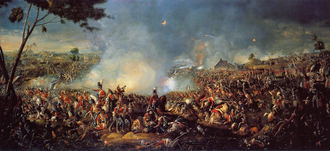 “The Battle of Waterloo”, painted by William Sadler. — William Sadler / Public domain
 “Napoleon on Board the Bellerophon”, painted by Orchardson c. 1880, showing the morning of 23 July 1815. — William Quiller Orchardson / Public domain
 “The Death of Marshal Ney”, painted by Jean-Léon Gérôme in 1868. — Jean-Léon Gérôme / Public domain
 Longwood House on Saint Helena, Napoleon's last residence. — Unknown author / Public domain
- Official channel of the Palace of Fontainebleau: video of the bicentenary commemoration of the “Farewell at Fontainebleau”. (Château de Fontainebleau)
- France 3 Paris Île-de-France news: two hundred years on, Fontainebleau re-enacts Napoleon's departure into exile. (France 3 Paris Ile-de-France)