Charles II (Charles II) — Kingdom of England (House of Stuart) (Kingdom of England (House of Stuart))
After Charles I was executed in 1649, his son Charles II spent eleven years in exile on the Continent. The Restoration of 1660 came not by fighting his way back but because General Monck, who had fought for Cromwell, turned around and welcomed him, on the condition of a prior promise of leniency. The Act of Indemnity and Oblivion accordingly pardoned the vast majority of those who had served the republic, excluding only the "regicides" directly involved in the trial and execution of Charles I: in October 1660 ten men were hanged, drawn and quartered, four more were executed in 1662, and Cromwell and two others were exhumed and hung at Tyburn; more than a dozen others were imprisoned for life, and twenty or so fled abroad. Monck and other defectors were made dukes and earls, and Cromwell's son lived safely to the age of 85. This was a reckoning with a list and a ceiling: Royalists complained that the act meant "indemnity for the King's enemies and oblivion for his friends." (Dates follow the Old Style calendar then used in England.)
How they were ousted
On 1649-01-30 his father Charles I was sentenced to death by Parliament's special court and beheaded at Whitehall, and England became a republic; the 18-year-old heir was in exile abroad, came back in 1651 at the head of a Scottish army, was routed by Cromwell at Worcester, and after six weeks in hiding escaped to France.
How they came back
After Cromwell's death the republican government collapsed, and General Monck, stationed in Scotland, marched his army into London and restored the old Parliament; Charles issued the Declaration of Breda promising a general pardon, the newly elected Parliament invited him home, and he entered London on 1660-05-29 (his thirtieth birthday).
What happened to the board
Of the 59 men who signed Charles I's death warrant, about 20 were already dead at the Restoration; of the living, 9 were executed (6 in October 1660, 3 in 1662), and together with the prosecutor Cook, the preacher Peter, the guard officers Axtell and Hacker, and Vane, who was not a regicide, 14 men in all went to the scaffold. Cromwell, Ireton and Bradshaw were exhumed, hung up and beheaded. The act separately listed 19 who had surrendered themselves, whose executions were suspended and most of whom were held until they died; about 21 fled to Switzerland, the Netherlands and New England, among them Lisle, who was assassinated by Royalists in Lausanne in 1664. Those who escaped the reckoning were the vast majority: Richard Cromwell was not prosecuted; Ingoldsby, who had signed the death warrant, was pardoned for helping the Restoration; Monck and Montagu, who had served Cromwell as general and naval commander, became a duke and an earl; Lenthall and seventeen others were merely barred from holding public office again.
Timeline
- Birth of Charles II Born at St James's Palace, London, the eldest son of Charles I. [Wikipedia: Charles II of England]
- Bradshaw becomes president of the High Court of Justice The Rump Parliament set up a High Court of Justice to try the King, with Bradshaw appointed president and Cook as chief prosecutor; the trial opened in Westminster Hall on January 20, with Axtell commanding the guard in the hall. [Wikipedia: John Bradshaw (judge)] [Wikipedia: John Cook (regicide)] [Wikipedia: Daniel Axtell]
- Charles I beheaded at Whitehall Fifty-nine judges signed and sealed the death warrant, Cromwell signing third and Harrison seventeenth. The executioner and his assistant wore masks, and their identities have never been established. [Wikipedia: Charles II of England] [Wikipedia: List of regicides of Charles I] [Wikipedia: Oliver Cromwell] [Wikipedia: Thomas Harrison (soldier)]
- Scotland proclaims Charles II king The Scottish Parliament proclaimed his accession in Edinburgh; he was crowned King of Scots at Scone on 1651-01-01. [Wikipedia: Charles II of England]
- Crushing defeat at the Battle of Worcester Charles led a Scottish army south and was routed by Cromwell at Worcester, with Lambert commanding the Parliamentarian right wing. Charles escaped from the city in the confusion. [Wikipedia: Charles II of England] [Wikipedia: Escape of Charles II] [Wikipedia: John Lambert (general)]
- Hiding in the oak tree at Boscobel Charles and Colonel Careless hid for a whole day in an oak tree near Boscobel House while Parliamentarian soldiers searched the woods below. The Pendrell brothers disguised and concealed him; afterwards Jane Lane had him travel with her dressed as a servant. [Wikipedia: Escape of Charles II]
- Reaches France On October 15 he put to sea from Shoreham with Lord Wilmot aboard the Surprise, landing the next day at Fécamp in Normandy. He spent the following nine years in exile in France, the Netherlands and the Spanish Netherlands. [Wikipedia: Escape of Charles II] [Wikipedia: Charles II of England] [英國王室官方網站:Charles II]
- Cromwell becomes Lord Protector The Instrument of Government, drafted by Lambert, came into force and Cromwell became Lord Protector. Harrison was expelled from the army for his opposition. [Wikipedia: Oliver Cromwell] [Wikipedia: John Lambert (general)] [Wikipedia: Thomas Harrison (soldier)]
- Cromwell dies and is succeeded by his son Richard Cromwell died of illness at Whitehall and was buried in Westminster Abbey; Richard Cromwell succeeded as Lord Protector and resigned a little over eight months later, on 1659-05-25, bringing the Protectorate to an end. [Wikipedia: Oliver Cromwell] [Wikipedia: Richard Cromwell]
- Monck marches his army into London Lambert tried to intercept him, but his army fell apart of its own accord. After entering London, Monck had the members purged in 1648 restored to their seats. On March 3 Lambert was sent to the Tower of London. [Wikipedia: George Monck, 1st Duke of Albemarle] [Wikipedia: John Lambert (general)] [Wikipedia: Charles II of England]
- The Declaration of Breda On Monck's advice Charles issued a declaration: a "free and general pardon" for all who acknowledged him as lawful king, with exceptions to be decided by Parliament; disputes over purchased estates and religious toleration were likewise left to Parliament, and the army's arrears of pay were to be made good. The drafters were Hyde, Ormonde and Monck's brother. [Wikipedia: Declaration of Breda] [Wikipedia: George Monck, 1st Duke of Albemarle] [Wikipedia: Edward Hyde, 1st Earl of Clarendon]
- Lambert's escape and rising fail Lambert escaped from the Tower of London in April, hoping to rally troops opposed to the Restoration, and was recaptured at Daventry (the entry gives the date both as the 22nd and as the 24th). [Wikipedia: John Lambert (general)]
- Parliament proclaims Charles king The newly elected Parliament assembled on April 25, had the Declaration of Breda read on May 1, resolved the next day that government ought to be by King, Lords and Commons, and formally proclaimed Charles king on May 8. On May 9 the bill of indemnity had its first reading. [Wikipedia: Declaration of Breda] [Wikipedia: Charles II of England] [Wikipedia: Indemnity and Oblivion Act]
- Enters London on his thirtieth birthday Montagu's fleet took Charles off from the Netherlands on May 24; he landed at Dover on the 25th and entered London on the 29th to the cheers of the crowds. [Wikipedia: Charles II of England] [Wikipedia: Edward Montagu, 1st Earl of Sandwich] [Wikipedia: George Monck, 1st Duke of Albemarle]
- Proclamation orders the regicides to surrender A royal proclamation required those who had taken part in the trial to come forward within a set time. The House of Commons originally meant to except only seven men (Harrison, Lisle and others); on June 7 it added Cook and three others plus the two masked executioners, and on the 8th resolved that a further twenty should suffer penalties not extending to life. And so the list kept growing. [British History Online:Statutes of the Realm(1660 年赦免與遺忘法全文)] [Wikipedia: Indemnity and Oblivion Act]
- Defectors ennobled; the former Lord Protector goes abroad Monck was created Duke of Albemarle, and Montagu was created Earl of Sandwich on July 12. On July 1 Vane was arrested; in the same month Richard Cromwell quietly left for France. [Wikipedia: George Monck, 1st Duke of Albemarle] [Wikipedia: Edward Montagu, 1st Earl of Sandwich] [Wikipedia: Henry Vane the Younger] [Wikipedia: Richard Cromwell]
- The Act of Indemnity and Oblivion receives royal assent The bill passed the House of Commons on July 11; the Lords sent it back with amendments, and the two Houses negotiated until August 28. Its contents: acts done during the Civil War and the republican period were all pardoned and consigned to "oblivion", but 49 named persons and the two executioners were not pardoned; the executions of 19 who had surrendered were suspended; the estates of Cromwell and three other dead men remained liable to forfeiture; Vane and Lambert were wholly excepted; Lenthall and 17 others were barred from holding public office again. Anyone who within three years abused another person over old grievances was to be fined. [Wikipedia: Indemnity and Oblivion Act] [British History Online:Statutes of the Realm(1660 年赦免與遺忘法全文)]
- Harrison hanged, drawn and quartered at Charing Cross Tried on October 11 and executed on the 13th, he was the first regicide to be put to death. The diarist Pepys was present and said he looked quite composed. [Wikipedia: Thomas Harrison (soldier)] [Wikipedia: List of regicides of Charles I]
- Ten men executed within a week Carew on October 15; Cook and the preacher Peter on the 16th; Scot, Clement, Scrope and Jones on the 17th, all at Charing Cross. On the 19th Axtell was hanged, drawn and quartered at Tyburn, and his superior Hacker was also hanged at Tyburn that month. [Wikipedia: List of regicides of Charles I] [Wikipedia: John Cook (regicide)] [Wikipedia: Daniel Axtell]
- Haselrig dies in the Tower of London The republican leader Haselrig, whose life had been spared, died in prison. [Wikipedia: Arthur Haselrig]
- Cromwell, Ireton and Bradshaw exhumed and posthumously executed On the anniversary of Charles I's death, the three men's bodies were dug up from Westminster Abbey, hung at Tyburn and beheaded at sunset; the bodies were thrown into a pit and the heads stuck on the roof of Westminster Hall. Pride was also ordered to be exhumed, but this was not carried out. [Wikipedia: Oliver Cromwell] [Wikipedia: John Bradshaw (judge)] [Wikipedia: List of regicides of Charles I]
- Coronation of Charles II The coronation was held at Westminster Abbey. [Wikipedia: Charles II of England]
- Three regicides brought back from the Netherlands and executed Okey, Barkstead and Corbet, who had fled to the Netherlands, were arrested and extradited home, and put to death in April 1662 (the entry on Corbet gives April 19). [Wikipedia: List of regicides of Charles I]
- Vane beheaded on Tower Hill Tried on June 6 without defence counsel, he was quickly convicted by the jury. Charles withdrew his earlier promise to spare his life. At the execution the authorities stationed trumpeters beneath the scaffold to drown out his dying speech. In the same year Lambert was sentenced to death, later commuted to life imprisonment. [Wikipedia: Henry Vane the Younger] [Wikipedia: John Lambert (general)]
- Lisle assassinated in Lausanne The regicide John Lisle, who had fled to Switzerland, was assassinated by the Irish Royalist James Cotter. Whalley, Goffe and Dixwell, who had fled to New England, were never caught; Dixwell lived out his days in New Haven under an assumed name, dying in 1689. [Wikipedia: List of regicides of Charles I]
- Clarendon impeached, flees to France Clarendon, the Lord Chancellor who had argued for leniency, left office on August 30, fled in November after being impeached by the House of Commons, and died abroad in Rouen in 1674. [Wikipedia: Edward Hyde, 1st Earl of Clarendon]
- Lambert dies after about 24 years in captivity He died on Drake's Island off Plymouth. The signatory Marten had already died at Chepstow Castle in 1680. [Wikipedia: John Lambert (general)] [Wikipedia: List of regicides of Charles I]
- Death of Charles II Died of illness at the Palace of Whitehall, aged 54. Cromwell's head was probably still stuck on the roof of Westminster Hall at this time. [Wikipedia: Charles II of England] [Wikipedia: Oliver Cromwell]
- Richard Cromwell dies at the advanced age of 85 The former Lord Protector returned to England around 1680 and spent his last years quietly at Cheshunt. [Wikipedia: Richard Cromwell]
- Cromwell's head is buried The head, which had passed from hand to hand, been collected and exhibited for more than two hundred years, was buried in 1960 beneath the antechapel of Sidney Sussex College, Cambridge. [Wikipedia: Oliver Cromwell]
People
- Charles II (Charles II), 1630-05-29 — Heir to the throne in exile; from 1660 King of England, Scotland and Ireland. Born at St James's Palace, London, the eldest son of Charles I. He left England during the Civil War and was 18 when his father was executed. In February 1649 the Scottish Parliament proclaimed him king, and on 1651-01-01 he was crowned King of Scots at Scone. Hereditary heir; he did not actually gain the English throne until 1660. It was the army and the Rump Parliament, led by Cromwell, that ordered his father tried and put to death; Monck and Montagu, who welcomed him back, had themselves both served Cromwell. Entered London on 1660-05-29, was crowned at Westminster Abbey on 1661-04-23, reigned for twenty-five years, and died of illness at the Palace of Whitehall on 1685-02-06, aged 54. [Wikipedia: Charles II of England] [英國王室官方網站:Charles II]
- Oliver Cromwell (Oliver Cromwell), 1599-04-25 — Parliamentarian general and regicide; Lord Protector 1653–1658. Born into the gentry of Huntingdon, he rose during the Civil War to become the most important general of the Parliamentarian army. In 1649 he was the third to sign Charles I's death warrant; in 1651 he routed Charles II at Worcester. Came to power through the victories of the New Model Army and the army's backing, and was installed as Lord Protector on 1653-12-16. Put Charles II's father to death, defeated Charles II himself, and ruled the country he should have inherited. Died of illness at Whitehall on 1658-09-03 and was buried in Westminster Abbey with the honours of a state funeral, more than a year before the Restoration. On 1661-01-30 (the anniversary of Charles I's death) his body was exhumed, hung on public display at Tyburn and then beheaded, and the head was stuck on the roof of Westminster Hall until at least 1684. [Wikipedia: Oliver Cromwell] [Wikipedia: List of regicides of Charles I] [British History Online:Statutes of the Realm(1660 年赦免與遺忘法全文)]
- John Bradshaw (John Bradshaw), 1602-07-12 — President of the High Court of Justice that tried Charles I. A Cheshire man, lawyer and judge. Appointed president of the High Court of Justice on 1649-01-10, he sat in a scarlet robe and a bullet-proof broad-brimmed beaver hat, with armour under his robes. Appointed by the Rump Parliament to preside over the trial; elected President of the Commonwealth's Council of State on 1649-03-12. Personally read out the charges against Charles I and the sentence of death. Died on 1659-10-31 and was buried with great ceremony in Westminster Abbey. On 1661-01-30 he was exhumed together with Cromwell and Ireton, hung at Tyburn until sunset and then beheaded, and his head was stuck up on Westminster Hall. [Wikipedia: John Bradshaw (judge)] [Wikipedia: List of regicides of Charles I]
- Thomas Harrison (Thomas Harrison), 1616 — Parliamentarian major-general and regicide (17th signature on the death warrant). Baptized in July 1616 at Newcastle-under-Lyme, where his father served four terms as mayor. Originally a law clerk in London, he joined the army in 1642, rose to major-general and was elected a Member of Parliament. In the 1650s he became a prominent figure among the Fifth Monarchists, and was imprisoned four times under the Protectorate for opposing Cromwell. Joined the Earl of Essex's lifeguard in 1642 and rose all the way to major-general. In 1649 commanded the guard that escorted Charles I to London, attended the trial and signed the death warrant. Refused to flee at the Restoration and was arrested in May 1660. Tried on October 11, he insisted he had acted by the authority of the Long Parliament; on the 13th he was hanged, drawn and quartered at Charing Cross, the first regicide to be executed in this way. [Wikipedia: Thomas Harrison (soldier)] [Wikipedia: List of regicides of Charles I] [British History Online:Statutes of the Realm(1660 年赦免與遺忘法全文)]
- John Cook (John Cook), 1608 — First Solicitor General of the Commonwealth and chief prosecutor in the case against Charles I. Baptized on 1608-09-18 in Leicestershire; a lawyer. From 1649 to 1650 he served as the Commonwealth's first Solicitor General. Assigned to prosecute the King on behalf of the state at the trial that began on 20 January 1649. He was not a judge and did not sign the death warrant, but it was he who stood in court and accused Charles I. Arrested in Ireland by Charles Coote, who had gone over to Monck, sent back to England and convicted of treason. On 1660-10-16 he was hanged, drawn and quartered together with the preacher Hugh Peter. [Wikipedia: John Cook (regicide)] [Wikipedia: List of regicides of Charles I] [British History Online:Statutes of the Realm(1660 年赦免與遺忘法全文)]
- Sir Henry Vane the Younger (Sir Henry Vane the Younger), 1613 — Leader of the Long Parliament and senior figure of the Commonwealth (not a regicide). Baptized in 1613 in Essex. As a young man he went to the Massachusetts Bay Colony, serving as governor in 1636–1637; after returning home he became Treasurer of the Navy and was a leading figure in the Long Parliament. From 1649 to 1653 he was in charge of the navy and trade on the Council of State; he returned to power when the Rump Parliament was recalled in 1659. He left Parliament after "Pride's Purge" at the end of 1648 and refused to approve the execution of the King; yet afterwards he served for years on the Commonwealth's Council of State. Arrested on 1660-07-01 and, together with Lambert, wholly excepted from pardon by the act. Parliament petitioned for his life to be spared and Charles agreed; but the newly elected "Cavalier Parliament" insisted on a trial, and on 1662-06-06 he was convicted without counsel, Charles withdrew his promise, and on June 14 he was beheaded on Tower Hill. [Wikipedia: Henry Vane the Younger] [British History Online:Statutes of the Realm(1660 年赦免與遺忘法全文)] [Wikipedia: List of regicides of Charles I]
- John Lambert (John Lambert), 1619 — Parliamentarian major-general and one of the architects of the Protectorate. Baptized on 1619-09-07 in Yorkshire. He distinguished himself repeatedly in the Civil War and commanded the right wing at the Battle of Worcester in 1651. In 1653 he took part in drafting the Protectorate's constitution, the Instrument of Government, and was later dismissed in 1657 for opposing Cromwell's taking the crown. After suppressing Booth's rising in August 1659, he became major-general of the whole army. He was named as a judge in the case against Charles I, but was at the siege of Pontefract at the time and did not attend, so he does not count as a regicide. In 1660 he was the only general who tried to stop the Restoration by force. Sent to the Tower of London on 1660-03-03, he escaped in April and was recaptured at Daventry. Excepted from pardon by the act, he was sentenced to death for treason in 1662, commuted to life imprisonment: he was held first on Guernsey, moved in 1667 to Drake's Island off Plymouth, and died there on 1684-03-01, having been confined for about 24 years in all. [Wikipedia: John Lambert (general)] [British History Online:Statutes of the Realm(1660 年赦免與遺忘法全文)]
- Sir Arthur Haselrig (Sir Arthur Haselrig), 1601 — Leader of the Long Parliament; republican. Born about 1601 in Leicestershire. One of the "Five Members" whom Charles I burst into the House of Commons to arrest in 1642. Helped bring back the Rump Parliament in December 1659 and joined the Council of State in January 1660. Approved of putting Charles I to death, but refused to serve as a judge. Despite Monck's guarantee, he was still pursued by Royalists after the Restoration and imprisoned; the act subjected him only to penalties not extending to life, so he kept his life, but he died in the Tower of London on 1661-01-07. [Wikipedia: Arthur Haselrig] [British History Online:Statutes of the Realm(1660 年赦免與遺忘法全文)]
- Henry Marten (Henry Marten) — Member of Parliament and regicide. One of the 59 who signed Charles I's death warrant. Biographical details were not researched this time. Member of the Long Parliament, appointed a judge of the High Court of Justice. Signatory of the death warrant. Surrendered himself under the proclamation of 1660-06-06 and was among the 19 named in the act whose "execution was suspended"; in practice he was imprisoned for life, dying at Chepstow Castle in 1680. [Wikipedia: List of regicides of Charles I] [British History Online:Statutes of the Realm(1660 年赦免與遺忘法全文)]
- Edmund Ludlow (Edmund Ludlow) — Parliamentarian general and regicide. One of the 59 who signed Charles I's death warrant; in his later years he wrote his famous memoirs. Biographical details were not researched this time. Parliamentarian army officer and judge of the High Court of Justice. Signatory of the death warrant. He first surrendered to the Speaker of the House of Commons, then slipped away and fled to Vevey in Switzerland, and was never brought back. John Lisle, who had likewise fled to Switzerland, was assassinated by an Irish Royalist in Lausanne in August 1664; Whalley, Goffe and Dixwell fled to New Haven in New England. [Wikipedia: List of regicides of Charles I]
- Richard Ingoldsby (Richard Ingoldsby) — Parliamentarian colonel and regicide. One of the 59 who signed Charles I's death warrant. Biographical details were not researched this time. Parliamentarian army officer and judge of the High Court of Justice. A signatory of the death warrant, but in 1660 he sided with Monck and helped bring about the Restoration. Pardoned for helping Monck, he was one of the very few signatories to come through unscathed. Another pardoned signatory, John Hutchinson, was barred by the act from holding public office, was implicated in a plot in 1663 and died in prison in 1664. [Wikipedia: List of regicides of Charles I] [British History Online:Statutes of the Realm(1660 年赦免與遺忘法全文)]
- Richard Cromwell (Richard Cromwell), 1626-10-04 — Son of Cromwell; Lord Protector 1658–1659. Born in Huntingdon, the son of Oliver Cromwell, nicknamed "Tumbledown Dick". Succeeded as Lord Protector on his father's death on 1658-09-03. The last man to occupy Charles II's throne. Under pressure from the army, he submitted his letter of resignation on 1659-05-25. He was never formally deposed or arrested, and simply faded from view. In July 1660 he left for France, using aliases such as "John Clarke"; he returned to England in 1680 or 1681, lived at Cheshunt in Hertfordshire, and died on 1712-07-12 at the age of 85. [Wikipedia: Richard Cromwell]
- George Monck (Duke of Albemarle) (George Monck, 1st Duke of Albemarle), 1608-12-06 — Commander of the army in Scotland; the driving force behind the Restoration. Born in Devon. He originally fought for the King, was captured at Nantwich in January 1644, and after about two years in prison changed to serving Parliament: he fought at the Battle of Dunbar in 1650, became a General at Sea in 1652, and was commander of the army in Scotland from 1655 to 1660. After his capture he went over to the Parliamentarian side and became a general under Cromwell, commanding the army stationed in Scotland from 1655. Marched his army into London on 1660-02-02 and had the purged members restored to their seats; he corresponded secretly with Charles through his brother Nicholas, a clergyman, and the Declaration of Breda was written largely along the lines he advised. Created Duke of Albemarle in July 1660, he joined the Privy Council and received the Order of the Garter, the office of Master of the Horse and other posts, and a pension, and from 1667 served as First Lord of the Treasury. He died on 1670-01-03 and was buried in Westminster Abbey. [Wikipedia: George Monck, 1st Duke of Albemarle] [Wikipedia: Declaration of Breda]
- Edward Montagu (Earl of Sandwich) (Edward Montagu, 1st Earl of Sandwich), 1625-07-27 — General at Sea of the Commonwealth. Born in Northamptonshire. A member of the Council of State from 1653 and General at Sea from 1656 to 1660; in 1657 he supported the Humble Petition and Advice, which asked Cromwell to take the crown. Member of the Council of State and General at Sea under the Protectorate. In May 1660 he took the fleet to the Netherlands and brought Charles II back to England. Created Earl of Sandwich on 1660-07-12 and awarded the Order of the Garter. On 1672-05-28, at the Battle of Solebay, his flagship was burned by a fireship and he was killed in action. [Wikipedia: Edward Montagu, 1st Earl of Sandwich]
- Edward Hyde (Earl of Clarendon) (Edward Hyde, 1st Earl of Clarendon), 1609-02-18 — Chief adviser to the court in exile; Lord Chancellor. Born in Wiltshire. An adviser to Charles I from 1641, he followed the heir into exile in 1646 and was appointed Lord Chancellor by the exiled Charles II on 1658-01-13. A veteran minister who had followed the Stuart father and son for nearly twenty years. One of the drafters of the Declaration of Breda; after the Restoration he worked hard to honour the promise of leniency toward the King's enemies (the regicides excepted), and the passage of the Act of Indemnity and Oblivion was mainly due to him. He remained Lord Chancellor until 1667-08-30. After the failures of the Second Anglo-Dutch War he was impeached by the House of Commons, fled to France in November, was then banished by act of Parliament, and died in Rouen on 1674-12-09: the man who helped the King return ended up worse off than many former republicans. [Wikipedia: Edward Hyde, 1st Earl of Clarendon] [Wikipedia: Declaration of Breda] [Wikipedia: Indemnity and Oblivion Act]
Moves to block a return
- More than just killing a king: a High Court of Justice set up by Parliament tried Charles I in public, sentenced him to death as a "tyrant, traitor, murderer and public enemy" and beheaded him before a crowd, after which England became a republic, with no throne left to inherit. [Wikipedia: John Bradshaw (judge)] [Wikipedia: Charles II of England] [Wikipedia: List of regicides of Charles I]
- A nationwide manhunt after the defeat at Worcester: a reward of one thousand pounds was offered for his whereabouts, and notices told soldiers to look out for a tall man, six feet two inches in height and dark-complexioned. Sheltered by a relay of Royalists in the countryside, he did not get out of England until six weeks later. [Wikipedia: Escape of Charles II] [Wikipedia: Charles II of England]
- The Protectorate tried to turn itself into a dynasty: the Humble Petition and Advice invited Cromwell to accept the crown (Montagu was one of its supporters); Cromwell was installed again as Lord Protector on 1657-06-26, and after his death in 1658 was succeeded by his son Richard. [Wikipedia: Edward Montagu, 1st Earl of Sandwich] [Wikipedia: Oliver Cromwell] [Wikipedia: Richard Cromwell]
- The last attempt to stop it by force: the republican general Lambert first tried to block Monck's march south, but his army fell apart of its own accord; he was sent to the Tower of London in March 1660, escaped in April hoping to rally his old troops against the Restoration, and was recaptured at Daventry. [Wikipedia: John Lambert (general)]
Rumors
- The masked executioner who cut off Charles I's head was such-and-such a person (various identifications have been made over the years). [Still unclear] The trials of 1660 and the various accounts that followed. The identities of the executioner and his assistant were never established, and the act could only refer to "two persons who stood masked upon the scaffold." William Hewlet was found to be one of them, but was reprieved because the evidence was weak. [Wikipedia: List of regicides of Charles I] [British History Online:Statutes of the Realm(1660 年赦免與遺忘法全文)]
- Charles II really did escape the search by hiding in an oak tree. [Later confirmed] The "Royal Oak" story that circulated widely after the Restoration. The escape can be traced through the names of his companions and a day-by-day itinerary; after 1660 the Pendrell family and other helpers received pensions, some of which are said to be paid to this day. [Wikipedia: Escape of Charles II]
- Charles II had promised to spare Vane's life. [Later confirmed] Parliament's petition of 1660 and the King's reply. Parliament's petition and the King's assent came first; after Vane's trial in 1662, Charles judged him "too dangerous to let live", withdrew the clemency and had him executed all the same. [Wikipedia: Henry Vane the Younger]
- How many regicides were put to death after the Restoration: the figures differ from book to book. [Still unclear] The Wikipedia entries themselves are inconsistent. The introduction to the list of regicides says 8, the table lists 9 signatories, and the Charles II entry also says 9; if the non-signatories Cook, Peter, Axtell, Hacker and Vane are counted in, 14 men in all went to the scaffold. The difference lies in how "regicide" is defined. [Wikipedia: List of regicides of Charles I] [Wikipedia: Charles II of England]
- Harrison was still alive when he was disembowelled, and rose up and punched the executioner. [Still unclear] Contemporary accounts of the execution. The entry records it in a "reportedly" tone; it cannot be verified. [Wikipedia: Thomas Harrison (soldier)]
- Bradshaw's body was shipped beforehand to Jamaica by his son and buried on a hill near Martha's Brae, with a cannon placed on top of the grave. [Proven false] An 18th-century legend. The entry regards this as 18th-century political folklore, very probably propaganda made up during the American War of Independence. [Wikipedia: John Bradshaw (judge)]
- The body hung up at Tyburn and the head stuck on Westminster Hall were not actually Cromwell's. [Still unclear] Many people suspected this even at the time: it was rumoured that his remains had been reburied several times between 1658 and 1661 to guard against Royalist reprisals. Wikipedia records only that "many people have questioned" it and how the doubt arose, without saying that the suspicion has been confirmed or refuted. [Wikipedia: Oliver Cromwell]
- The four dead principal offenders excepted from pardon, Cromwell, Ireton, Bradshaw and Pride, were all exhumed and put on public display. [Proven false] A common simplification. Only the first three were exhumed; the order to exhume Pride was issued but not carried out. [Wikipedia: List of regicides of Charles I] [British History Online:Statutes of the Realm(1660 年赦免與遺忘法全文)]
Views
- Historians (as summarized by Wikipedia): Most historians have praised the generosity Charles II and Clarendon showed over this act. [Wikipedia: Indemnity and Oblivion Act] [Wikipedia: Edward Hyde, 1st Earl of Clarendon]
- Howard Nenner (historian): "Regicide" was not an offence in English law: it was a sin, not a crime; the defendants were tried for treason. [Wikipedia: List of regicides of Charles I]
- Summary in the Wikipedia entry "Charles II": Known for being easy-going and affable, but he gave away almost nothing about his real political calculations. [Wikipedia: Charles II of England]
- Official website of the British Royal Family: The official profile says only that he spent nine years in exile after the defeat at Worcester and was invited back to London in 1660 to resume the throne; it says not a word about the reckoning with the regicides. [英國王室官方網站:Charles II]
- John Bradshaw (president of the High Court of Justice): He pronounced the King a tyrant, traitor, murderer and public enemy. [Wikipedia: John Bradshaw (judge)]
- Disappointed Royalists: They gibed that the act gave indemnity to the King's enemies and oblivion to the King's friends: the government did not help recover Royalist estates that had been confiscated and sold off. [Wikipedia: Indemnity and Oblivion Act]
- Thomas Harrison (at his trial): He admitted no wrong, maintaining that what he had done was done by the lawful authority of the Long Parliament. [Wikipedia: Thomas Harrison (soldier)]
- Samuel Pepys (diarist, eyewitness to the execution): He noted that Harrison still looked cheerful in that condition. [Wikipedia: Thomas Harrison (soldier)]
- Charles II: His judgment was that this man was too dangerous to be left alive. [Wikipedia: Henry Vane the Younger]
Photos & videos
 Charles II, by John Michael Wright (or his studio), c. 1660s. — John Michael Wright / Public domain
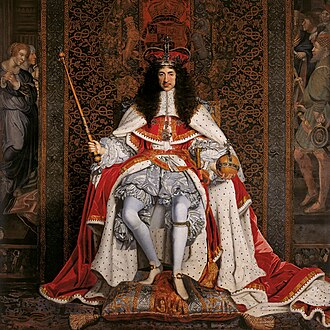 Charles II in coronation robes, by John Michael Wright, c. 1661. — John Michael Wright / Public domain
 His father Charles I, studio of van Dyck, after an original of 1636. — Workshop of Anthony van Dyck / Public domain
 The High Court of Justice trying Charles I in Westminster Hall, January 1649 (17th-century engraving). — Uncredited engraver / Public domain
 The death warrant of Charles I, bearing the signatures and wax seals of 59 judges; in 1660 it became the list for pursuing the regicides. — Unknown author / Public domain
 Charles I beheaded outside the Banqueting House, Whitehall (engraving, c. 1649). — Unknown author / Public domain
 The Banqueting House, Whitehall, London: in 1649 the scaffold was erected just outside it. — en:User:ChrisO / CC BY-SA 3.0
 Cromwell at the Battle of Worcester (1651-09-03), 18th-century engraving. — James Caldwell / Public domain
 "King Charles II in Boscobel Wood", by Isaac Fuller, depicting the escape after the defeat at Worcester. — Isaac Fuller / Public domain
 The "Royal Oak" at Boscobel, photographed in 2011. — Sjwells53 / CC BY-SA 3.0
 Oliver Cromwell, after an original by Samuel Cooper. — After Samuel Cooper / Public domain
 General Monck, Duke of Albemarle, studio of Peter Lely: from Cromwell's general to the man who did most to bring about the Restoration. — Workshop of Peter Lely / Public domain
 Cromwell's head, a news photograph of 1911; after he was exhumed and beheaded in 1661, the head stayed stuck on the roof of Westminster Hall for more than twenty years. — Anonymous (unsigned - both pages of the 1911 article were examined, at archive.org) / Public domain
 Interior of Westminster Hall: the King was tried here in 1649, and from 1661 the heads of Cromwell and the others were stuck on its roof. — Tristan Surtel / CC BY-SA 4.0
- Official video from Historic Royal Palaces: The death of Charles I, the execution of a king. (Historic Royal Palaces)
- Official lecture from the Cromwell Museum: Cromwell's head, his death and what happened afterwards. (Cromwell Museum)